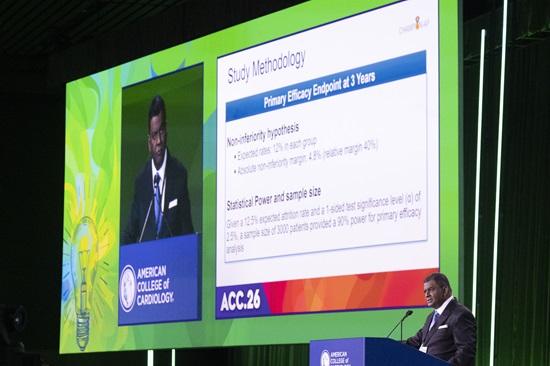
For patients with non-valvular atrial fibrillation (AF) who had no contraindications to taking oral anticoagulants, the use of a device to close off the left atrial appendage (LAA) in the heart was comparable to standard medication therapy in reducing the combined rate of all-cause stroke, cardiovascular death and systemic embolism at three years in the CHAMPION-AF trial, from which results were presented for the first time at the American College of Cardiology’s (ACC) annual scientific session (28–30 March 2026, New Orleans, USA). Moreover, closure of the LAA was found to be superior to long-term oral anticoagulation for prespecified major and non-major non-procedural bleeding in these patients.
The LAA closure device used in this clinical trial—the Watchman FLX device (Boston Scientific)—is currently indicated and US Food and Drug Administration (FDA)-approved for use in patients with AF who cannot tolerate or take long-term anticoagulants due to previous bleeding episodes, or a high risk of bleeding, especially if they are prone to falls. According to researchers, it was unknown prior to the CHAMPION-AF trial whether LAA closure is at least as effective and safe as blood thinners in this group of patients.
“Although non-vitamin K antagonist oral anticoagulants [NOACs] are currently the preferred treatment approach for reducing stroke risk in these patients, their effectiveness may be limited by risks associated with bleeding and medication non-adherence,” said Saibal Kar (Los Robles Regional Medical Center, Thousand Oaks, USA), co-principal investigator of the study. “Our data suggest that the LAA closure device used in this trial is a potential and reasonable alternative to medication—even among patients who are suitable for long-term blood thinners—and may be discussed as part of a shared decision-making process.”
CHAMPION-AF is said to be the first prospective, multinational randomised trial to test whether LAA closure is non-inferior to NOACs in patients who are able to take long-term blood thinners irrespective of whether they have undergone prior AF ablation.
The study included 3,000 patients (average age, 72 years; 32% women; 85% white) with non-valvular AF who had a moderately elevated risk of stroke (average CHA2DS2-VASc score, 3.5) and low bleeding risk (mean HAS-BLED score, 1.3) at 141 sites across Australia, Belgium, Canada, Denmark, France, Germany, Israel, Italy, Japan, the Netherlands, Poland, Saudi Arabia, Spain, Switzerland, the UK, and the USA. A total of 1,501 patients were randomised to receive a NOAC at the discretion of the treating physician and 1,499 were randomised to undergo LAA closure with the Watchman FLX device, which was inserted via a catheter through a blood vessel in the groin.
After three years of follow-up, 5.7% of patients in the LAA closure group and 4.8% of those in the medical therapy group experienced the trial’s primary efficacy endpoint—a composite rate of ischaemic stroke, haemorrhagic stroke, cardiovascular death and systemic embolism—which met non-inferiority, according to Kar. When researchers looked at each of the components of this co-primary endpoint individually, they found no difference in deaths, systemic embolism or haemorrhagic strokes, but saw slightly more ischaemic strokes among those undergoing the procedure.
“There was a slightly higher number of ischaemic strokes among people in the LAA closure group—3.2% versus 2% among those in the medical therapy group, but event rates were low in both groups—and this is something we will look at again at five years,” Kar commented.
Results for the primary safety endpoint—the combined occurrence of major and non-major but clinically relevant non-procedural bleeding at three years—showed that those in the medical therapy group had almost twice the rate of bleeding events. Bleeding occurred in 10.9% of those in the LAA closure group and 19% of those in the medical therapy group.
“This is an important finding because we studied people who we thought were good candidates for blood thinners—they are not contraindicated for long-term anticoagulation and they have low bleeding risk—and, in spite of that, they had increased bleeding over time,” Kar said.
The study also had two prespecified secondary endpoints, and met both, according to Kar. The first—the combined rate of major bleeding, both procedural and non-procedural, at three years—met non-inferiority for LAA closure as per rates of 5.9% in the LAA closure group and 6.4% in the medical therapy group. The secondary net clinical benefit endpoint was a composite of cardiovascular death, stroke, systemic embolism and non-procedural bleeding, with the data demonstrating that the LAA closure device was superior to medical therapy (15.1% vs 21.8%, respectively).
The researchers also conducted a secondary analysis that looked at major and clinically relevant non-major procedural and non-procedural bleeding—and found that, at three years, the LAA closure group had fewer events compared to the medical therapy group (12.8% vs 19%, respectively).
“The success of the landmark CHAMPION-AF trial represents a meaningful milestone that will undoubtedly transform the treatment approach to stroke risk reduction in a broader population of patients who historically have needed to rely on medication,” commented study co-chair Martin Leon (Columbia University Medical Center, New York, USA), as quoted in a Boston Scientific press release. “These results should give clinicians confidence in the potential of the Watchman FLX device to become a first-line treatment option for reducing the risk of stroke for a rapidly growing number of patients with AF.”
According to the researchers, as the CHAMPION-AF trial only used the Watchman FLX device and a specific post-implant treatment regimen, these results may not be generalisable to all LAA closure devices. Additionally, the results may not apply to patients with advanced heart failure with very low ejection fractions, as those patients were excluded from the study.
Within the trial, Kar and colleagues are set to follow patients for five years to determine whether LAA closure is non-inferior to blood thinners regarding ischaemic stroke and systemic embolism over the longer term.
Alongside Kar’s presentation at ACC 2026, findings from the CHAMPION-AF trial were simultaneously published in the New England Journal of Medicine.