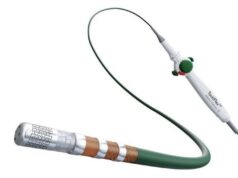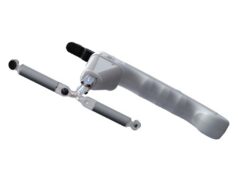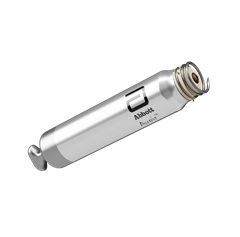
Abbott announced this week that the US Food and Drug Administration (FDA) has approved its Aveir VR Mini ventricular leadless pacemaker (LP)—the latest-generation ventricular device in Abbott’s Aveir leadless pacing platform.
The shorter length of this device expands implant options within the right ventricle and creates more implant options in the treatment of patients with slow heart rhythms, Abbott claims.
Together with the company’s Aveir AR2 atrial LP, the Aveir VR Mini ventricular LP represents the next evolution of the Aveir DR LP system—the “world’s only” dual-chamber leadless pacemaker. Powered by Abbott’s “first-of-its-kind” implant-to-implant (i2i) in-body communication technology, the Aveir DR system enables beat-to-beat communication between two leadless pacemakers to maintain synchronous activation of the heart.
The Aveir VR Mini ventricular LP is shortened from 38mm to 32.5mm—a 14% reduction compared to the existing Aveir VR ventricular LP—to deliver “industry-leading ventricular longevity” in a smaller form factor, according to Abbott, thus providing an additional option for patients who would benefit from use of a lower-profile device.
Abbott also notes that, unlike traditional pacemakers, leadless pacemakers are implanted directly into the heart through a minimally invasive, catheter-based procedure, eliminating the need for cardiac leads. The procedure leaves no chest scar, and the device is not visible to the eye.
“Abbott is advancing leadless pacing, and expanding options for physicians and patients,” said Randel Woodgrift, senior vice president of Abbott’s cardiac rhythm management business. “Together, Aveir AR2 and Aveir VR Mini represent the next generation of the world’s only dual-chamber leadless pacing system, giving physicians a highly optimised atrial and ventricular pairing that expands the reach of this technology to a broader patient population.”